Join us at one of our upcoming virtual Graduate School Open House events on Zoom! You'll have the opportunity to learn more
about Ä¢¹½¶ÌÊÓƵ, understand the Graduate School application process,
and meet key program representatives.
The M.S. in Experiential and Outdoor Education is a two-year, full-time hybrid program.
The hybrid coursework is a mix of online and face-to-face weekend (Friday and Saturday)
core class sessions during Year 1, and elective courses (offered online, face-to-face
and hybrid) in Year 2. In the first year, face-to-face coursework includes a 5-day
intensive during the first week of classes in August on the Cullowhee and Asheville
campuses followed by four weekends each in the fall and spring semesters (8:00AM -
6:00 PM Friday and Saturday with an occasional evening session and 3 days in April)
and one online evening class session each week. This format allows students to remain
employed and/or to pursue other opportunities alongside their graduate studies.
What You'll Learn
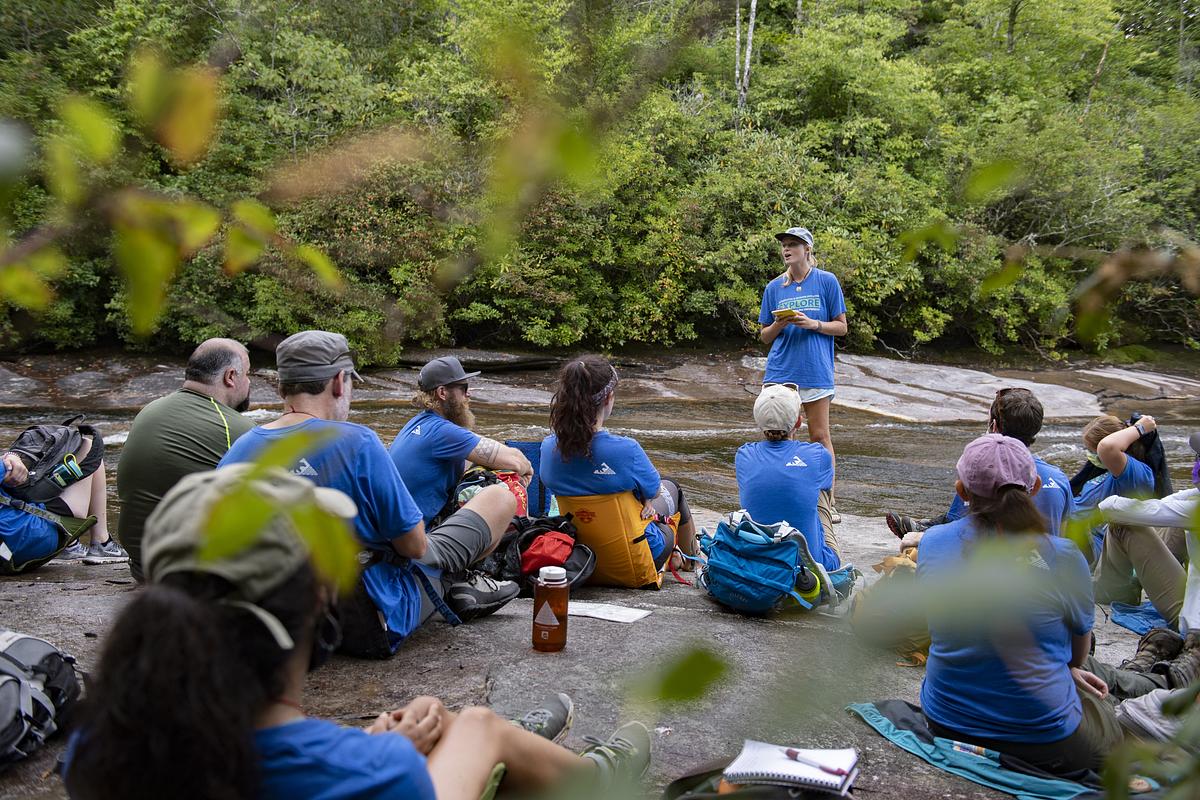
The M.S. in Experiential and Outdoor Education degree utilizes the philosophy of experiential
education combined with the modality of outdoor education to provide students with
the necessary training to serve in a variety of educational contexts. In this program,
students will:
Develop a theoretical and philosophical foundation for experiential and outdoor education.
Design learning experiences for a variety of populations and settings that integrate
theory into practice.
Demonstrate various teaching methods and group facilitation techniques for diverse
populations and settings.
Prepare and present a final thesis or project designed to meet a need in the field
and/or fill gap in the academic literature and rooted in a thorough understanding
of research methods and practices-see examples.
Required courses include topics such as philosophy and theory of experiential and
outdoor education, current trends and issues, and group facilitation and teaching
methods. Electives include topics such as interpreting the natural world, outdoor
and sustainability education, and a scholarly writing intensive. Travel courses to
locations like the Boundary Waters Canoe Area and Costa Rica are also offered on a
rotating basis an elective option during the summer term between year one and year
two. See the full program curriculum for further details.
Where You'll Go
The M.S. in Experiential and Outdoor Education degree works well for a wide range
of professionals who work in outdoor and educational programs including: expeditionary
learning schools, charter schools, independent schools with an experiential education
program, community colleges, residential and day camps, environmental education programs,
therapeutic experiential agencies and camps, university outdoor programs, and wilderness
leadership programs. Some students enroll in the program as a part of a career shift
while others plan to use the additional training to enhance their current professional
work. Students have disseminated their thesis or project work via various presentation and
publication outlets. See examples here.
Learn more about the application and admission process via the links above, or keep
scrolling for more program details.
Degree Options
School
College of Education & Allied Professions, Department of Human Services and Experiential
Education
Location
Hybrid: Online, Asheville, & Cullowhee
See Face-to-Face Class Dates below for location specifics.
Program Length
Full Time
4 semesters (fall & spring year 1, fall & spring year 2) + optional summer electives
between year 1 and year 2
App Deadline
Priority deadline is Feb. 1
Applications received after Feb. 1 are reviewed on a rolling basis through June 1
for any remaining seats in the cohort.
Credits:
36 credit hours (27 core, 9 elective)
More Ä¢¹½¶ÌÊÓƵ Our Master of Science in Experiential & Outdoor Education Program
Ä¢¹½¶ÌÊÓƵ’s M.S. in Experiential & Outdoor Education offers advanced, graduate-level preparation
for professionals who want to design, lead, and evaluate transformative learning experiences
in outdoor, experiential, and adventure-based settings. Students deepen their understanding
of experiential learning theory, program design, outdoor leadership, environmental
stewardship, and social-emotional development—grounded in a framework that emphasizes
inclusive facilitation and ethical practice.
Through a blend of rigorous coursework, field-based application, and opportunities
for independent or collaborative research, students build the knowledge and practical
expertise needed to create meaningful learning environments. The program supports
both thesis and non-thesis pathways, allowing students to align their graduate experience
with career goals in outdoor education, nonprofit leadership, K–12 and higher education,
environmental education, youth development, and adventure programming.
The EOE program's hybrid structure provides students the flexibilty to balance coursework
with their existing work or field commitments.
The EOE curriculum blends experiential education philosophy with outdoor education
practice, providing both theoretical and practical foundations for academic and professional
success.
Graduates complete the program with a versatile set of skills – combining experiential
education theory, research, facilitation, and practical program design.
Face-To-Face Class Dates
Below are directions to the Biltmore Park instructional site and the Cullowhee main
campus, as well as tentative class dates.
(Cohort 7 Face-to-Face; All-Day Sessions for EOE 500, EOE 501, EOE 502 & EOE 503) EOE 500 – 5-day intensive (August 17-21) (Cullowhee and Biltmore Park) Weekend 1 – August 28-29 (Biltmore Park) Weekend 2 – October 2-3 (Biltmore Park) Weekend 3 - November 6-7 (Biltmore Park) Weekend 4 – December 4-5 (Biltmore Park) **Cohort 6 Thesis and Project Oral Proposals are September 30, October 1 & 2 at Biltmore
Park
Tentative Spring 2027
(Cohort 7 Face-to-Face; All Day Sessions for EOE 600, EOE 601, and EOE 602) Weekend 1 – January 15-16 (Biltmore Park) Weekend 2 – February 19-20 (Biltmore Park) Weekend 3 – March 12-13 (Biltmore Park) Weekend 4 – April 22, 23 & 24 (Biltmore Park) *3 Days **Cohort 6 Thesis and Project Defenses are March 10, 11 & 12 at Biltmore Park ***Optional elective faculty-led-travel course: EOE 628: Scholarly Writing Intensive
for EOE; Edisto Island, SC; January 16-22, 2027
Tentative Fall 2027
(Cohort 8 Face-to-Face; All-Day Sessions for EOE 500, EOE 501, EOE 502 & EOE 503) EOE 500 – 5-day intensive (August 23-27) (Cullowhee and Biltmore Park) Weekend 1 – September 10 & 11 (Biltmore Park) Weekend 2 – October 8 & 9 (Biltmore Park) Weekend 3 - November 5 & 6 or November 12 & 13 (Biltmore Park) Weekend 4 – December 2 & 3 (*note this is a Thursday/Friday) (Biltmore Park) **Cohort 7 Thesis and Project Oral Proposals are October 6,7 & 8 at Biltmore Park
Tentative Spring 2028
(Cohort 8 Face-to-Face; All Day Sessions for EOE 600, EOE 601, and EOE 602) Weekend 1 – January 21 & 22 (Biltmore Park) Weekend 2 – February 18 & 19 (Biltmore Park) Weekend 3 – March 17 & 18 (Biltmore Park) Weekend 4 – April 27, 28 & 29 (Biltmore Park) *3 Days **Cohort 7 Thesis and Project Defenses are March 15, 16 & 17 at Biltmore Park ***Optional elective faculty-led-travel course: EOE 628: Scholarly Writing Intensive
for EOE; Edisto Island, SC; January 23-28, 2028
What’s Happening
NOV
04
NOV
04
NOV
04
Related Programs
Explore our related programs until you find the one that’s right for you.